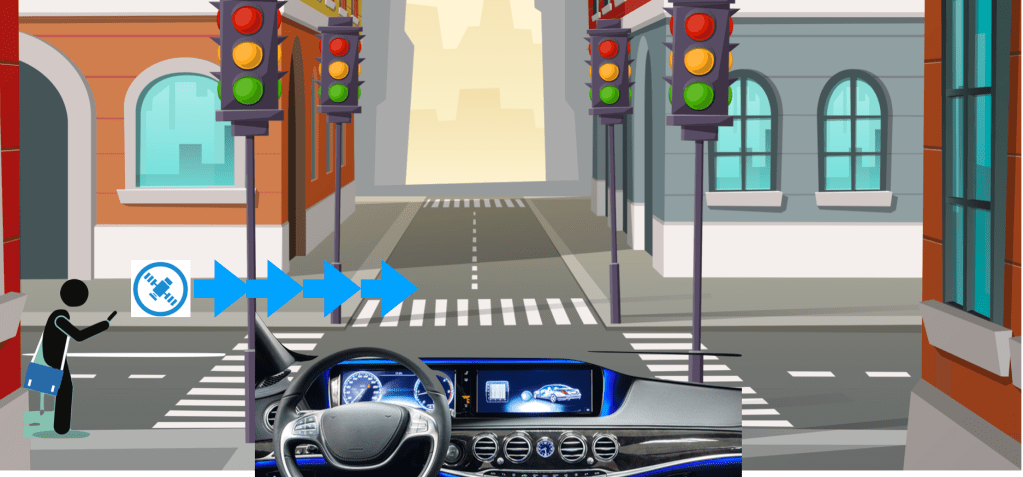
Innovating by transposing concepts and integrating technologies.
Transposing concepts from the air to the ground, merging and integrating available technologies in order to create new value.
The TCAS system was introduced in aviation in order to prevent collisions between aircrafts. TCAS sends warnings to both aircrafts having an imminent risk of collision and provides them instructions to clear the risk.
Down to the ground, a new wearable device, the “Walking Angel”, will send the positioning data to all vehicles moving in the area thanks to the widely used online maps service providers. Cars automation will complete the work in order to prevent vehicle-pedestrian collisions.
The scope of the Walking angel is to make the pedestrian “visible” by the car or by the vehicle computer before it can be seen or detected by the driver or by the vehicle sensors.
The Walking Angel is a tracker using the 5G technology. Data is transmitted much faster compared to previous mobile technologies.
The latency issue is solved.
Should the pedestrian or the vehicle be warned of a risk?
A Practical Framework developed by (NISHA VINAYAGA-SURESHKANTH et. al., 2018) identifies the opportunity to detect a pedestrian distracted behavior and to alert the person in case of danger.
On the other hand, the car that brakes for pedestrians do exist. This video explains how:
(Ford Europe, 2014)
The Walking Angel uses a different approach: the target of notification is the vehicle which will be the performer of corrective actions.
“A probabilistic model integrating Gps data can be used to calculate the trajectory of a vehicle” (Peng Has et. al, 2017).
The Walking Angel data is used to allow the vehicle computer to compute the vehicle and pedestrian trajectories. The risk of collision can be estimated before the onboard sensors (cameras and radars) can detect the pedestrian.
Distractions do happen. According to to Barin, E.N., McLaughlin, C.M., Farag, M.W. et al. (2018), a sign reminding pedestrians to avoid distractions while crossing has an effect at short term with a very low cost.
“Drivers using mobile phones are approximately 4 times more likely to be involved in a crash than drivers not using a mobile phone” (Who.int , 2018)
Distracted or not, drivers and pedestrians can be in the same time close but without “visual” contact.
A common situation: A pedestrian walks hidden by a building and suddenly crosses the road. The car nor the driver cannot detect the person.
Hopefully both vehicle and pedestrian trajectories can be estimated.
Having solved the latency issue with with the adoption of the 5G technology, the position accuracy turns out to be next challenge.
According to (Elmezayen A, El-Rabbany , 2019), ” The release of the world’s first dual-frequency GPS/Galileo smartphone, Xiaomi mi 8, in 2018 provides an opportunity for high-precision positioning using ultra low-cost sensors”.
The Walking Angel provides precise positioning low latency data data to the vehicles computers which compute both vehicle and pedestrian trajectories.
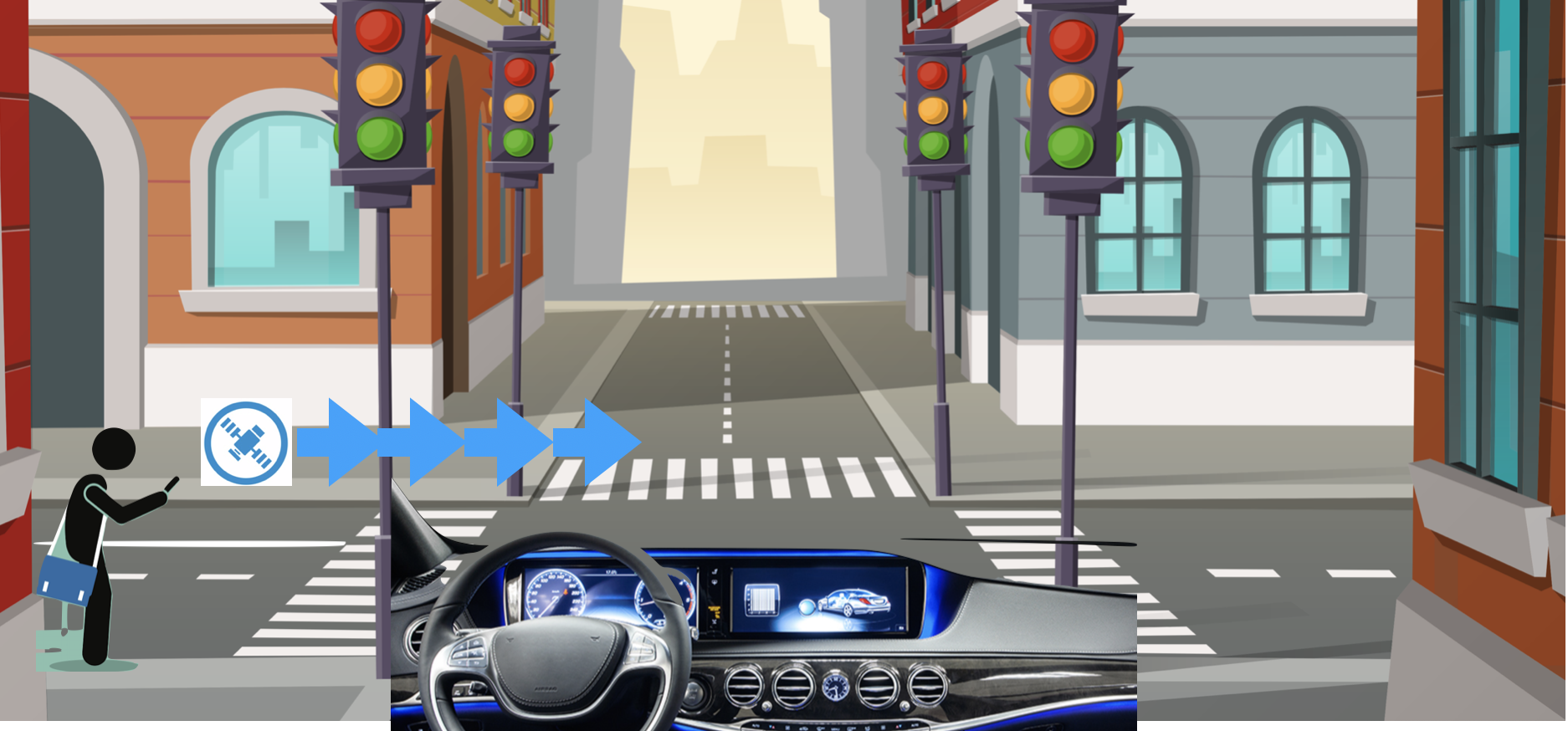
The walking Angel explained:
The vehicle computer receives constant high-precision position updates from the 5G network and evaluates if the trajectories may lead to a collision.
The possible actions performed by the vehicle may be the activation of a cockpit warning notified to the driver, together with acoustic and light warnings issued to warn the pedestrian.
While the risk of collision persists, the previous warnings are repeated and the vehicle brakes with all the available capacity until the risk is cleared.
Prevention is better than cure.
Pedestrians can purchase a wearable gps tracker at low cost. Insurance companies may be interested to cover the costs, as the reduction of accident damage claims would be an economic advantage.
For insurance companies and public health systems costs reductions achieved by accidents prevention may justify an investment to bring the Walking Angel on the Road.
References
A Practical Framework for Preventing Distracted Pedestrian-Related Incidents Using Wrist Wearables,
NISHA VINAYAGA-SURESHKANTH 1, ANINDYA MAITI2, MURTUZA JADLIWALA 1,
KIRSTEN CRAGER3, JIBO HE3,4, AND HEENA RATHORE, 2018.
Barin, E.N., McLaughlin, C.M., Farag, M.W. et al. J Community Health (2018) 43: 810. Retrieved from https://doi-org.salford.idm.oclc.org/10.1007/s10900-018-0488-y on
WHO (2018): Road traffic injuries. [Online] Available at: [Accessed 24 Aug 2019]
Ford Europe (2014): The car that brakes for pedestrians. [Video online]. Available at: [Accessed 24 Aug 2019]
Peng Hao, Member, IEEE, Kanok Boriboonsomsin, Member, IEEE, Guoyuan Wu, Senior Member, IEEE, and Matthew J. Barth, Fellow, IEEEIEEE: TRANSACTIONS ON INTELLIGENT TRANSPORTATION SYSTEMS, VOL. 18, NO. 3, MARCH 2017
Elmezayen A, El-Rabbany A. Precise Point Positioning Using World’s First Dual-Frequency GPS/GALILEO Smartphone. Sensors (Basel, Switzerland). 2019;19(11). doi:10.3390/s19112593.
 Alessandro Filippi